The database for the twodos app was dropped because of a misconfigured environment variable, causing existing users to be logged out of accounts and unable to access their data for a while.
The problem has been resolved since and data has been restored. You can access the service here on twodos.app website or download the client apps.
Cause
The Docker image used for the deployment of backend API had an extra environment variable NODE_ENVIRONMENT added. The objective was to make the Docker image a development instance by default. On production, environment variables would be configured to override the development/staging values.
There was a data layer code that reads this variable on app start up and purges all the data from the database.
The sequelize database being force created when the Node environment is development.
This line was not gated properly and read a single variable to make such a big decision. The gate has been two-factored and an additional environment variable is now expected before the data can be purged making it difficult to enter this gate by mistake. Especially on production environments.
Impact
The misconfigured environment variable caused the database tables to be dropped with the data being truncated. This led all the existing users to lose the access to the application and the data that they had created.
This was detected first on staging environment and then was propagated to the production environment.
Resolution
The impact on existing users was minimal. The data is now recovered, and the application is performing normally.
To prevent this from happening again, the data layer environment gates have been two-factored to prevent single environments from purging the databases. Moving forward, to make such changes on a database, two variables need to be set that indicate the intention to remove or modify the data.
The data backup was used to rollback to an earlier version of the database.
Sincere apologies for the inconvenience caused.
The changes applied are part of a wider effort to make the application simpler, stable, and scalable on the UI-part. The changes in the API will make it possible to extend and improve:
Users and account management, to allow easier account creation, login, sharing, and access management for privacy reasons.
Lists and tasks management, to better expose the lists and tasks actions so that native platforms can compliment the data (add reminders, change the themes, etc.)
State management of the application to make the application faster.
Improved testing of the platform (API + app) to ensure the application performs and delivers what it aims to deliver.
We’ve received feedback from you all, especially around:
Emails and tokens not being delivered.
Application breaking (especially state management).
Lists and the tasks management UI being unclear.
We’re moving slowly toward releasing the application with all the improvements deployed a) first to our API and then b) a new version of the app on the client platforms.
I have a three-year-old. We never gave her a screen time until she was already 1 year old and even then it was slow-paced content that does not turn her into a zombie. Now, she knows how to play content via Google commands and it is often difficult to control her; but it was possible to control what she watches. Until about 4-6 months ago. The AI slop is destructive to your child’s development, brain development, and does not really teach your child anything.
I was watching content with my daughter when I realized that the content generated on this channel is actually extremely poor quality. Toby Town.
Disclaimer: I am not saying this is the only channel that has AI generated content (the “AI slop”), or poor quality content. There are so many examples of channels that generate content via AI and directly publish it to YouTube.
YouTube has recently started controlling and limiting the AI generated content, because, let’s be real. It’s plain stupid, lame, and sloppy. Sloppy on the content side and sloppy on the responsibility side of the creator. For me, the following three are the biggest concerns when it comes to the content. And before I share that, I honestly, do not care what my child (in a child-friendly manner) watches. If she wants to watch rock climbing, I’ll watch with her, if she wants to watch how to make buildings with magnetic tiles, I’ll buy a bunch of magentic tiles and build with her. What I would not accept is the content that damages her connection to the reality. And this is the outline or the boundary that I have set. So let’s take a look at why AI-generated content is wrong for your kids.
#1 Physically inaccurate behavior
Even in 2026, AI lacks a connection to the real world. AI does not know how objects behave in motion. Everyone is enjoying the ASMR videos of sun being cut into two, or how frozen nitrogen sounds when cut by a damascus steel made out of wood. When you read the statement, you can already picture different elements and know what is possible and what is not. If you are not able to differentiate between that from the sentence above, then perhaps, you can stop reading further. This article is not for you.
I gave Gemini this prompt and this is the video that it generated this video:
The Gemini-generated ASMR video lacks sense, but provides what’s asked and demanded.
For fun, it makes sense to have such ASMR content. But for the kids who are learning every second, this video does not really teach them. And if you overstimulate their learning experience with such “fake” content, it is damaging to their development.
A child is still in the learning phase, and they need to learn what is possible, what sounds are there, how mass works, before anything.
My bike teacher told me the perfect one-liner: it is easy to learn, but it is extremely difficult to unlearn what you have learned.
The videos demonstrate such movement that will not be possible in this physical world. The little brains that are just learning how the movement works, are more likely to be confused by the AI-movement than appreciate it.
#2 Auditory and visual coordination
For starters, various videos do not have the audio and visuals match the scenario. The facial expressions do not match the emotion of the scene, the audio does not cue what may happen. Another problem is, time over time, I’ve seen videos where an audio and a video clips are merged together that do not belong together. Even if they are from the same publisher or creator, they do not match the on-screen behavior. A short example of this is, this video, where the on-screen content is a video about “BINGO the dog“, but the sound is about “boo boo song“.
The AI slop is sloppy because it is produced with quantity in mind and not quality.
The more you watch this content, the worse it gets. The captions say something else, the “speaker” sings something entirely different. There is a label on the top that again has nothing to do with the content on the screen. The content is a stop-motion animation.
And this is not the only example, this was actually the final straw where I decided that I needed to write this piece. You can look at this video and it shares the same story.
#3 AI doesn’t know how to cry
I have seen my daughter learn a lot from the content on YouTube. When I look at her building structures out of magnetic tiles, or when she demonstrates creating blobs out of clay dough, it makes me happy. I am happy that YouTube is a platform that can provide her a demonstration of “possible”. My daughter learned alphabets from YouTube, she sings along Ms. Rachel, she “claps her hands” with Super Simple Songs. At the end of a video, she has “done something”. Or at least she is building the neural network to be able to do something. The other day she was snapping her fingers at me.
AI-generated content will not be able to demonsrate this. You look at a child crying, or demanding something, and you can see there is a clear different between a child crying and a tantrum. AI content does not distinguish between these two.
Alright, so what to do?
When it comes to AI slop, I guess the only answer is to avoid it at all costs. It is not helpful for your baby, and honestly, it is not help for you either. Your baby will not only be watching content that is not real, the baby will have a hard time differentiating what’s real and what’s possible (think of objects flying through other objects, just because AI thinks that’s possible).
Today, AI-generated content is not limited to videos with generated persons but also for cartoons. These cartoons often do stuff that is not practical, but also not ethical. Since the person (or studio) generating this AI content has only one focus: generate more content. They have no time for quality control or review. Often time they ask AI to further review the content or make it compliant, which the AI does so by adding a label. Even the label does not conform to the content that is actually in the video. A simple label via the simplest video editor would take less time, but the person generating the content has no interest in doing so. Because they are so lazy.
#1 Track what your child watches
I have not given my daughter a separate account, she has a shared account that I can check the history of. I review the content, and I often set the content myself that she would want to watch. Here is how it goes:
Me: “alright, let’s put some video on the TV, which one would you like to watch?”
She: “that one” — as she points to a video with highest saturation in colors.
Me: “nope, that is bad, how about you watch either this video, or that video, or perhaps the last video you really loved?”
She: *thinks a little and makes a choice* “this one, this one”
Me: *plays the video and watches “with her”*
Note that the keyword is “with her”. I don’t put the video on and then grab my phone. I watch the content so that she finds it equally interesting.
Notice how one of the reasons why CoComelon’s videos are less advised for younger children because of the color saturation; YouTube video. In my opinion, it’s better to let your child bump to “baby shark do do do” than this AI-slop.
#2 Downvote the content
YouTube is also locking on to the AI-generated slop content so that they can reduce the number of times it appears. I have not seen useful AI-generated content, yet. The most recent interesting AI-generated (or at least CGI) video was this rollercoaster video that I watched with my daughter. It makes sense to have this CGI or AI-generated content for such scenarios and I am okay with that. The difference is that the CGI generated content is at least reviewed before getting published.
I always downvote a video that reflects the top 3 problems that I’ve listed above. Even though I still receive a recommendation to watch the video again (or another similar AI-generated video). Over the last few weeks, I’ve seen and shown no interest in several videos that often have similar content repeated.
The content, I’ve experienced, continues to reappear but you can continue to avoid and skip the content. YouTube algorithm is very complex, but the amount of slop that is being created can easily fool it. The problem is not that AI slop is being created, the problem is everyone thought it was an easy way to get quick views, subscriptions, and start earning on the platform. This greedy push for monetization flooded the platform with such content. In December, YouTube actually started to fight back on this AI content and a lot of creators saw their content getting less and less views, to a point where some videos are just getting zero views (check Reddit, I don’t mean to point fingers at anyone here).
#3 Have the “tough conversation.”
Our children do not stop watching or consuming content just because we told them. They really need to understand what is okay and what is not okay.
What really worked for me was first telling what AI was (of course, not the whole machine learning course) and then tell why this was not useful. I demonstrated some examples where a baby is sliding on mud and there is no scratch on the baby’s knees. After this explanation, I would give my child a choice that would make them feel in control and in charge. I would decide on the options and they will make a choice.
And like everything else, this is a repetitive approach and you would need to repeat this behavior again and again. The AI videos would continue to show for a while, but your child does not have to watch them.
Did you need to have a tough conversation with your child regarding AI? Honestly, this conversation has been the toughest one so far with my 3-year old. I had to explain what AI is, to explain why she should not watch AI-generated content.
This was it for today, I’ll catch you in the next blog. And if you read until this, I have something to share. I am starting a newsletter on this website and would be sharing similar content in a recurring cadence. If you found this content useful, would you consider subscribing?
Or, let me know what I missed. I’d appreciate that.
A good resource to further read and learn about the Schengen visa rejection reasons can be found on this website (ticket2travel.world). In this post, I will not cover all the reasons for rejection because some of these can be personal and very serious. However, I will cover the most common reasons that they provide which are mostly because you did not provide good documents to support your travel or departure reasons. The notable reasons or the common ones are:
10. The information submitted regarding the justification for the purpose and conditions of the intended stay was not reliable.
13. There are reasonable doubts as to your intention to leave the territory of the Member States before the expiry of the visa.
So, you applied for a Schengen visit visa (maybe via the Dutch embassy) and your visa application was rejected because the visa officer was not convinced by your application, supporting documents, or other material that you are applying for the right visa category with the right documents. The visa rejection is not a red alert about you or your passport, it is just that based on your submission, you do not qualify for a visa. Once you receive the response, you have two choices:
Apply again with fresh set of application and supporting documents.
Appeal against the visa rejection decision made by the visa officer.
The decision you make does not impact the outcome you will have. You can receive a visa if you apply again (providing the right documents, and explaining the change in circumstances since you last applied) and you can get a rejection in an appeal if you still cannot convince the authorities or satisfy the requirements for the visa.
One example is: you say that you are travelling to the Schengen states to watch a football match, but your travel itinerary says you want to be in the Schengen states for 45 days, your financial situation does not support this, or you do not have work. In this case, the visa officer is likely to reject the visa application.
Note that your visa application is judged based on what you submit in the application (along with supporting documents).
Now, let’s fast forward, you’ve heard the bad news and you are ready to take the next step.
The easy way: Apply again
While a Schengen visa rejection decision can be appealed, it differs per embassy and country. Some countries have a transparent, easy, and smooth procedure to apply for an appeal, others, not so much. In all cases, you are always allowed to reapply. However, note that if you do reapply, make sure to:
Review, study, and understand why your visa was rejected in the first place. Mostly, a visa is rejected because a document was missing, your plan was not properly communicated, or you did not submit enough supporting documents to prove that you would leave the Schengen states before the expiry of your visa.
Apply with the supportive documents that you believe you missed or were not able to submit in the earlier application.
Clearly communicate to the visa officer that you understand why the visa was rejected, and what circumstances demonstrate a change in the situation or compel the visa officer to make a different decision this time.
Reapplying is a new application. You need to make a new application, submit all the documents (including the visa application) again. You will need a new appointment, pay for any visa application fees, and then wait for the new decision.
Since this is a new application, the decision can be either a Visa approved or Visa refused, and you will receive the rejection reasons again. If you receive a visa, then you will receive a stamp in the passport that you can use to travel to the Schengen states. If your visa is rejected, then you will receive the reasons why the visa officer is still not convinced by the documents that you have provided to support your application.
P.S. I have not yet created an outline for applying for a Schengen visit visa or how to sponsor your friends and family for a Schengen visit visa. I will update this blog once I have published the blog.
Now, with the visa application rejected again, you can attempt to appeal against this decision.
The other way: Appeal
Appealing a rejected visa application is a way that not many take. Appeal is your right if you believe that the provided rejection reasons are not grounded, and that you provided enough material to prove and demonstrate to the visa officer why you should be granted a visa.
Note: This guide is primarily for visas applied through The Netherlands embassy for a Schengen visit visa, mainly for friends and family visit. For other countries, a different procedure may apply and the rejection reasons document would provide more information, such as where, when, and how to apply for an appeal. You can read more about appealing your visa rejection on the IND website. You can read how you can appeal a Schengen visa rejection.
An appeal is an official request to have your visa application decision reviewed. An appeal can take up to 6 months of time. If you would like to travel urgently, an appeal is never going to help you. Only appeal for a visa decision review if you have about 6 months to travel, or you can travel after 6-7 months without any impact on the travel or the reasons to travel. In the Netherlands, the appeal can be made:
Directly yourself.
Your friend or family (if you applied for a friends and family visa).
A legal representative.
How to appeal?
You can submit an appeal directly to the IND and provide reasons for why you want to start the appeal procedure. IND will officially receive the application, and start the appeal procedure for your visa application. IND can provide you with further material that you can use to understand why the visa application was denied, and how you can provide supportive documents. IND expects further information, mainly written documents that prove the facts and statements. This can include any changes to the financial, personal, relational, social, or economic ties to your current country.
IND can request documents that they deem needed to proceed with the appeal. Once you submit the documents, IND takes the due legally allowed time to make a decision.
It is often a good practice to use a legal representative to start the appeal procedure with the IND. There are various reasons:
The legal council is more experienced in the immigration laws and can better convey your message to the IND in legal terms.
The legal council has most likely supported a similar client in the past and they know what the IND is expecting, and what you must provide to better support your case. Note that while you may think otherwise, every small or ignorable detail is important in making your case strong. For example, do you have social connections or responsibilities? They count.
The legal costs can be covered if you meet certain requirements.
The legal representative can also support you in making a decision (the final decision is always your own!). So, you end up making an informed decision and not a decision in haste. Especially, if you are going to wait for 6 months to hear back from the IND, you want to make sure you submit everything so that you hear the good news.
Visa approved
If your visa is approved, you will receive a decision from the IND stating that your visa appeal was found well and that the decision is now reversed. You can use this decision to reapply for a visa. When you apply with the letter from IND, you have to submit your passport and pay the visa fees.
The embassy will stamp the visa in your passport and return it to you. You can then travel to the Schengen states using the visa.
Visa denied
It is equally possible that the rejection appeal also fails and results in the appeal being rejected and visa rejection decision being sustained. This is indeed sad. But it is possible.
If this happens, you can proceed and have the appeal rejection fought in a court where a judge makes a decision. This is the next step and the judge can rule in your favor if your provide facts and supporting material, but the rejection can also be sustained.
A Schengen visa on your passport can mean easy movement between the Schengen states and visit Germany, The Netherlands, Italy, France, and other countries and be able to have that EURO Tour you wanted. A rejection can definitely shatter those dreams, but you always have a choice to reapply or appeal.
Did you learn something in this post? Did I miss something? Let me know and I can update the blog to reflect the needed information.
The Dutch are really good with English language and you can use English language as a way of communication across offices, schools, playgrounds, markets, and for regular life; with neighbors etc. You do not need to be fluent in Dutch to be able to live in the Netherlands.
You do need to learn Dutch if you would like to extend and convert your current temporary residence permit to a permanent residence permit or become a Dutch citizen through naturalization. At the time of writing this article, the current level requirements for the language experience is A2 for a permanent residence or naturalization as per the Immigration and Naturalization Service (IND).
Learning Dutch
If you have been learning German, then Dutch could seem quite similar to you at first. One of the major difference is the pronunciation of several words, and then, the several words, and the articles (Dutch language has two articles only 1/ de and 2/ het).
Dutch, while they are welcoming to speaking English with you, are even more welcoming to teach you basics of Dutch.
Tip: Even a Dutch person knows that it is difficult to speak Dutch.
Challenges
The biggest challenge learning Dutch is the availability and reliability of the English speakers. The Dutch quickly switch to English as soon as they realize that you do not speak Dutch. I have an experience where the Dutch person quickly switched to English to make sure that we are having the right conversation and the conversation is leading to the right direction.
I was taking a Dutch language course and after a few weeks the assignment was to place an order in Dutch at a restaurant. I went to a local restaurant that I really love and I tried to place order.
Me: “Voor mij, een portie friet”. The shopkeeper quickly switched to English and asked me, “What size?” I responded, “Klein”, he said, “Is this take away or for here?” I replied “meenemen”.
This felt very unnatural because I was making an effort to speak Dutch but the person was making sure that they are getting the order right, it would not be fun for them if they got the order incorrect.
Next, while this is not a major problem, but the Dutch “G” is a challenge to speak for many. Personally, as a native Urdu speaker, I do not find it difficult as we have a “خ” (pronounced: “Khay”) and that made it a very easy experience.
The Dutch alphabet is also easy, just a different pronunciation.
Opportunities
Learning Dutch is also very easy, and there are various opportunities for you to learn Dutch. In my experience, I used the following opportunities:
Speaking with neighbors, friends, and colleagues
Listening to radio, TV, paying attention to stations, announcements, etc.
Reading weekly newspaper, advertisement, and other Dutch material.
I always pay close attention to the conversations in the grocery stores (not like peaking into personal conversations) but to understand how the shoppers ask questions, what is the response, how do directions work, and more.
At the moment, the Dutch language experience requirement is A2, which is not hard. If you just read weekly material, have a conversation with neighbors, you are way ahead of your peers.
“Inburgeren” Experience
I took the A2-level Inburgeren exam here in the Netherlands — I took it in Amsterdam. The DUO exam center is in Overamstel, and you can book an exam online at inburgeren.nl.
The DUO exam center for the inburgeren exams for expats in the Netherlands.
The exam can be taken in other locations as well, but, prefer to find a location that is closer. A few pointers:
Always bring your valid ID card (passport, driver’s license, residence document) to prove that you are the person taking the exam.
Arrive at least 30 minutes before your exam time, this is to give you enough time to check-in, put your stuff in the locker, check your exam data, and be allowed to sit in the exam before the door closes. Yes, the door does close before time.
Ramp up your Dutch “cells” before the time, and practice before the exam day, not just before the exam.
Planning
Truth be told, I had been planning for the language exam since 2023 (3 years in the Netherlands) and at this point I could at least read and understand some words, at least listen to what they are saying.
I planned to integrate into the Dutch society for several reasons, including applying for permanent residence, but also to understand the society a little more, to be able to participate in the Dutch conversations.
Preparing
I am the kind of person who prefers to prepare way ahead of the exam, not just one day before the exam. Infact, if I do not know anything or if I feel that I am not prepared, I’d rather not prepare anymore. Opening a book, or reading the guides, right before the exam raises my stress levels, and I believe it would not contribute anything.
Think like this, what if right before the exam you learned a new formula or a sentence structure, when you get a question what would you do? Even if you know the answer, you may reconsider your answer because a new “fresh formula” is running in your mind.
Dutch inburgeren is not tough. The tough part is thinking like a Dutch. A lot of people try to cram the material or practice all 50 online practice exams, but that does not cut it. You really need to spend time in the culture, meet your neighbors, order food in local, read the paper, and pay attention to how people interact in the market, in the train, in work environment, and on the street.
The preparation for the Dutch inburgeren takes months, not weeks. But, the inburgeren exams, that is a different story and everyone has their own pace. For me, it took about 1 year.
Participation
I started my inburgeren exams back in 2023, and the objective was not to complete all the exams in one month, but to get an idea of how it would be like. I decided to take an exam, and reading made the most sense. I booked all the exams directly via the website and it costs 50 EUR per exam (when I did the exam, it was 50 EUR, the price may change).
I will add more details for each exam type and any tips as I collect more details and resources. Thanks!
One thing to note in the Inburgeren exam is, you are graded based on your understanding of the question. If your answer is perfect in grammar, but does not make sense as the right answer, then you do not get a grade. If you understand the question, you get half the points, and if you provide a perfect answer then you get the remaining half points as well. The “perfect answer” means correct use of grammar, right pronunciation, etc.
Listening and Reading
Like I mentioned, I took the reading exam first. I did the reading exam because I knew I can read Dutch, even if I cannot listen to it. The reading exam does not challenge you to produce the answer, rather it offers you a few choices that you have to use to decide which is the right answer. So, given all the information your task is to find what is the most obvious answer. I did IELTS a few years back and I had a small muscle to skim the text content and find the answer out of the options.
The reading exam was rather easy and simple, and I passed the exam. Since the exam takes place on a computer, and the options are selected on the screen, it is comparatively easy to evaluate the results and provide a grade. I was aiming for 8.
Passing the reading exam gave me the motivation to continue pushing and get done with all the exams. On the Listening exam, I repeated the same method. The exam is on computer, and you receive the results in 8 weeks (in practice, it is usually much faster, I got my results in a week).
I passed this exam as well. In one go. This motivated me a lot. And now I was ready to move on to the next. As a next step, I wanted to do writing, because it was medium difficulty but did not require me to learn about different insurances, benefits, and responsibilities.
Writing
Writing exam is a fun, but different exam. As the name suggests, you must write the answers to the questions.
Everyone is given a piece of paper that has questions on them and then you must provide a response within the bounds provided. You can cutout a mistake, but you must stay within the bounds of the answer field.
I only have one recommendation: stick to the question, and do not over answer the question. If they ask for your favorite dish, do not write down the recipe.
Writing exam also takes 8 weeks to provide a grade, I received my grades in about 5 weeks. I passed this exam as well, and I was now ready to proceed with the next exam. I decided to do KNM, as I was still scared of “speaking Dutch”.
Speaking
I did speaking exam at the last. The only reason why I was scared of speaking Dutch, and I was not comfortable “creating” sentences ad-hoc. I was able to understand, read, and even write a response back, but speaking was still challenging.
I practiced speaking a lot with my colleagues, and in the neighborhood before scheduling an exam. I took about 1 month to prepare for the exam and when I was ready, I just made an attempt.
Note: I made an attempt on an older version of the speaking exam. Now, the speaking exam has been updated.
The exam takes place on computer, and you listen to questions that you must respond to in Dutch. Some questions are singular questions (“what is your name”) and some questions are multiple, such as (“what do you like to eat, how do you make it?”) The multiple questions were very difficult because you have to think of two sentences and then merge them together using either “omdat” or “want”. I always used “want”. Do you know why? 🙂
The exam results take about 8 weeks, and I got my grades in about 6 weeks. I passed the exam. I was relieved that I now finally have the grades and a diploma for inburgeren.
Note: I did not do the labor market orientation, because I was working in the Netherlands and I could apply for an exception.
KNM
For me, this was the most challenging exam. The reason being, it demands a lot of knowledge and understanding of Dutch society, Dutch history, Dutch social security, work culture, and your rights, as well as the rights of others.
The exam is also multiple choice questions, where you select the right answer for the question. The focus is on how you would react in given situations as a Dutch person. This is why I recommend spending at least 4-6 months interacting with Dutch natives and understanding how they do things.
Learn about the social security, work culture, healthcare, childcare, family, housing, and other aspects of the Dutch society. History, education, and sports also play a crucial role in the exam and you should take a shot at learning more about that.
Free Resources
If you’re also learning Dutch, I’d like to share some resources that really helped me gain knowledge, insights, and experience in the language. Of course, these are only complimentary services and solutions. Use these along with real-world practice with your neighbors, classes, coworkers to learn how the native Dutch pronounce certain words.
Duolingo
The first and foremost choice for many is Duolingo.
I have been doing Duolingo lessons for several years now, and I can vouch that Duolingo works in the long-term and not in the short-term. If you are attempting to clear the Dutch exam in a month or so, then Duolingo is not a good option for you.
Do:
Find a time when you will do a lesson each day. It is the best way to build up a habit of doing Duolingo.
Do one lesson, or a max of two, each day, and build up a muscle memory to pick up new vocabulary.
Do work with friends and coworkers, because one of the objectives of Duolingo is to offer gamified way of learning.
Don’t:
Overdo the lessons.
Don’t do tens of lessons each day, as you will be setting Duolingo on hard mode for yourself.
Just rely on Duolingo.
Dutch Grammar
This website gives you an idea about the Dutch grammar, sentence structure, and other parts of a Dutch sentence. The website is available free of cost, and focuses on beginner-friendly content.
I really, really, really love the material provided by the Groningen University Language Center. Check out their YouTube channel here. On their YouTube channel, they provide a lot of courses (playlists) for you to learn A2-level Dutch.
The content on the channel is free, and you can use language cafes and communities to practice the learnings.
Did I miss something? Were you looking for something else? Please let me know in the comments below, and I’d be happy to add more details to the blog above. I am still collecting all the details and experience that I had from my exams. I will update the post and add relevant information and tips.
Happy New Year, everyone. May this year bring blessings, happiness, joy, and luck to you and your family.
In this post, I am sharing the customs and the traditions of the Dutch and what I did–of course, I cannot take a cold dip.
New Year in the Netherlands
The Dutch really celebrate the new year, every year. And I mean, they really celebrate it. The top things they do, which, we can say are a cultural thing here now:
Celebrate with sweets; they tend to give gifts, and mostly enjoy Oliebollen. The Oliebollen are a type of donuts (doughtnuts), and is a Dutch delicacy.
Light up fireworks; this year alone the Dutch consumers spent over 129 million euros on fireworks. Which is a record high.
Take a dip; the New Year’s Dive is a traditional dip in the beach. The residents go to beaches and take a dip, but definitely, stay careful and vigilant. While the primary points remain the biggest beaches, such as Scheveningen, you can take a dip in your nearest beach too. There was an event planned in Almere Haven for the residents.
My New Year
I wanted to do something different. While the year started similarly, I decided to do a clean up of my street on the first day of the year. In Almere, we had a lot of fireworks and all that firework left a mess on the street. It has become a bad habit that people who enjoy the fireworks do not clean up after themselves. This trash is left for days and sometimes for weeks. The local municipality does the cleaning over the course of the next days, but that is too much work on their hands alone.
So I decided to give them a hand.
I started by cleaning the street. The objective was:
Clean and remove all the debris from the street.
Put the debris in a plastic bag and dispose of properly in a metal container.
It took me about half an hour. A little bit more, but after the half an hour, the street was clean. The debris was removed.
Fun fact: I had a neighbor stop me and tell me that it was not my responsibility, and instead, the people who used the fireworks or the municipality should clean it up. That is a very interesting take, and I respect it, however, if there is a delay or perhaps the authorities are busy, it can be done by ourselves too. After all, I call it my home so it is my responsibility to keep it clean as well.
Missed Opportunities
I still feel that I missed out on wishing everything a blessed year in my street. I could not connect with everyone on my street, and that would be on my list for the coming year.
For the neighbors, I would aim to deliver at least a wishing card to give greetings.
For the neighbors, that I have not had an interaction with, I will plan to have at least a coffee with them.
For the neighbors, that I have already met at least once, I would plan an activity.
The new year should give me a milestone to plan an activity and stay connected with my neighbors and community.
I have been using OneDrive for years, and it has worked always. However, few times I experienced that the data was no where to be found. And, I would always blame it on myself that perhaps I did not save it, maybe I saved it in a different folder, and sometimes I just thought perhaps there was no data.
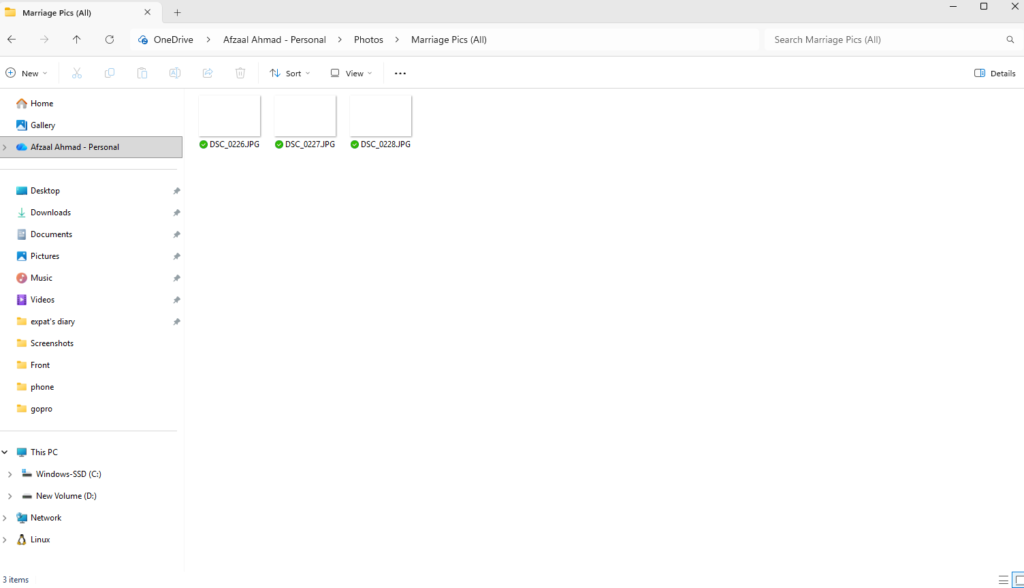
One example of this is that I created a folder to put all the pictures of my marriage (from 2020) and now when I open the folder I cannot find the content that I had put there.
Figure 1: The images are not found. I cannot claim what happened because this event was around 4 years ago. However, I do remember what happened 4 hours ago.
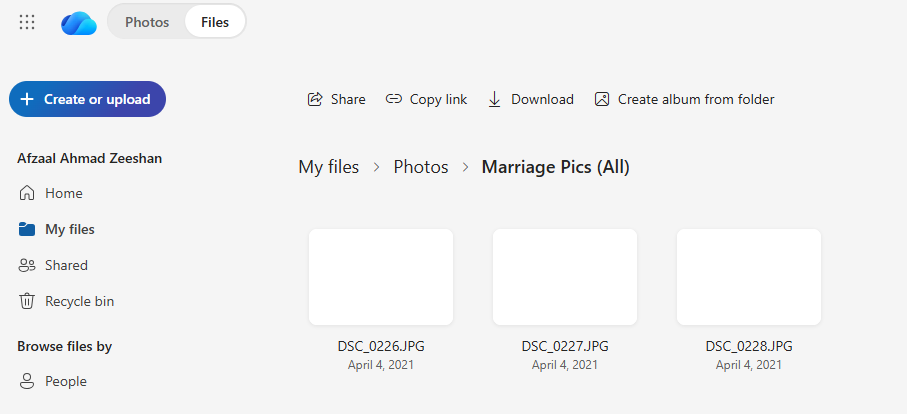
I can see that the folder was created back then, but there is literally nothing in the folder. I have accepted the fate and I can review the photos on Google Photos instead. Here is the only three pictures left in the folder, and as noted by the date these were uploaded back in 2021–given such a date, why would I risk my own marriage photos being lost?
Figure 2: The folder has some files from 2021 and that’s it.
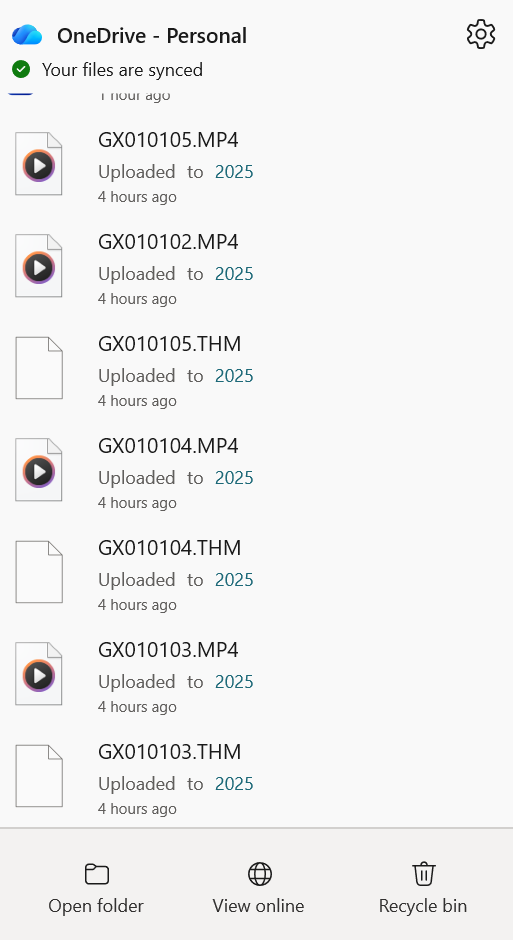
It wasn’t until last week when I had just uploaded a copy of very important data; video footage from my GoPRO, and I could swear that I uploaded it only to see that the data is not there anymore. Here are the two screenshots that show the activity:
Figure 3: The OneDrive widget shows that the file was uploaded 4 hours ago to the folder.
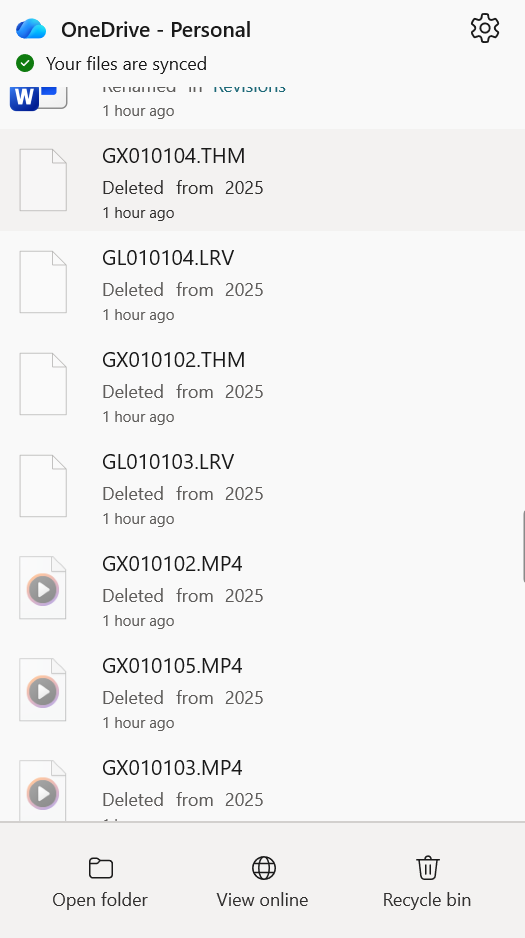
The content was uploaded to the folder (I named it 2025) and then after a few hours I could not find the content. Here is a log in the system that says that the file was deleted.
Figure 4: The files were deleted from the OneDrive folder locally and thus from the online platform too.
I cannot find the files in the recycle bin, or anywhere and there is no way to read the logs on what happened.
Problem
I can understand one of the following reasons to have happened:
I deleted the files, by mistake, or through a keystroke (such as CTRL + Z).
I deleted the files by resynching the folders using a different machine (my mobile, a different laptop)
The network glitched and the files were deleted.
What I cannot understand is why is there no logs of the activity in the system.
The online folder details tab shows logs, but it does not show:
When was the content deleted?
Who deleted it?
Is there a way to recover the files?
It should be possible to see what is happening, who is making changes, and be able to revert those changes for up to 30 days–which in this case was not met.
OneDrive Subscription
I am not using a freemium version of OneDrive, and this is what’s causing me to panic because. If this set of files can be deleted, I wonder what else could be deleted? The premium version of the OneDrive (or Microsoft 365) is not a cheap subscription and one of the perks is the paid cloud storage. I do use it for personal projects, most YouTube videos that I make have their content saved in OneDrive. I would like to control and audit the activity in my account.
I share this account with my family and that means they also use the services for their activities. If they lose the data, that is not good either.
References:
This Reddit thread talks about a similar challenge that the author was facing.
Have you recently moved to your own place in the Netherlands? Are you looking for internet services? This blog is for you. While the network coverage on the mobile networks is excellent and can be used to stream all day and night long, you sometimes need a connection to provide Wi-Fi services and to connect your devices to the network without having your phone’s battery drained because of the hotspot.
In Pakistan, there is a limited option and availability for the internet services. The leading platform is definitely PTCL, while new players are entering the market that provide a better service, customer service, and competitive prices.
If you live in a region where the fiber service is not available, then good luck connecting to the service and internet on a rainy day. The major problem is that the top speeds in Pakistan are still limited compared to the Netherlands. Here is a quick comparison between the internet services provided in Pakistan and the Netherlands.
Comparison between the internet speed in Pakistan and in the Netherlands.
In Pakistan, the procedure is to request a connection service from the provider (PTCL, for example) and then they ask you for a connection plan. You can chose to go with basic copper-wire service or use a fiber connection to your home (if the service is available).
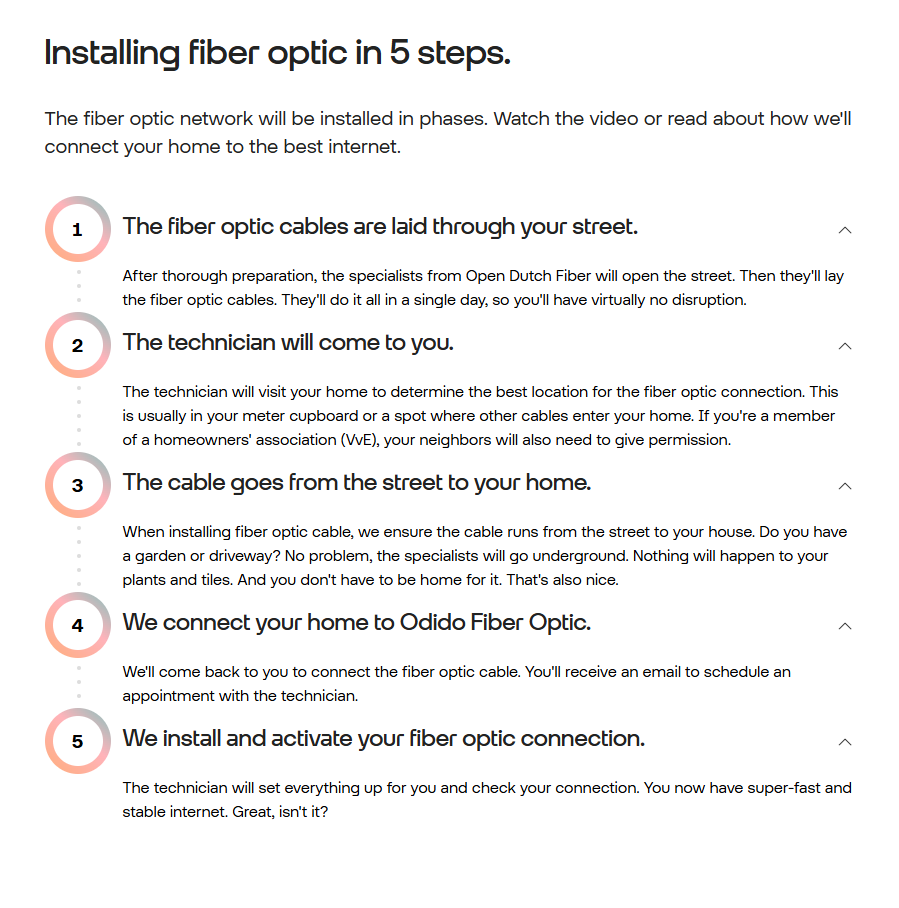
In the Netherlands, however, that is not the procedure. In the Netherlands, each house is equipped with the connection already. You do not need to get the underlying connection. You do need to get the connection set up.
Figure 1: The optic fiber installation procedure details on the Odido website.
If you’d like to read the specifics, check it out here on Odido’s website. Let’s start by reviewing the providers available and what services they offer.
Internet Providers
In the Netherlands, you can pick your own providers, the contract terms, the speed, and any additional add-ons. The internet providers provide:
Internet (of course)
Phone services (landline connections)
TV-connections
Each service provider offers the same bunch of services, just at a different rate, different offerings, and different contract terms. The usual contract terms are fixed for 1 year and then you can switch to a new provider. Every year there is a promotion for new customers and you can save a lot of money if you switch to the new provider. This is a big challenge, given you may have to change the Wi-Fi passwords on all devices. The leading internet providers are:
As a consumer, you do not need to worry about what and how the underlying elements work. You only buy a subscription, have a technician connect you to the network and surf cat videos.
Quick facts:
The Netherlands plans to have fiber optics installed in nearly all homes by the end of 2026. You can find the fiber coverage on most websites, like this one.
You can transfer your phone number to a new service provider free of cost when you take out a new subscription.
You always get a 14-day cooldown period, during which you can change or cancel your subscription free of cost.
Price Comparison
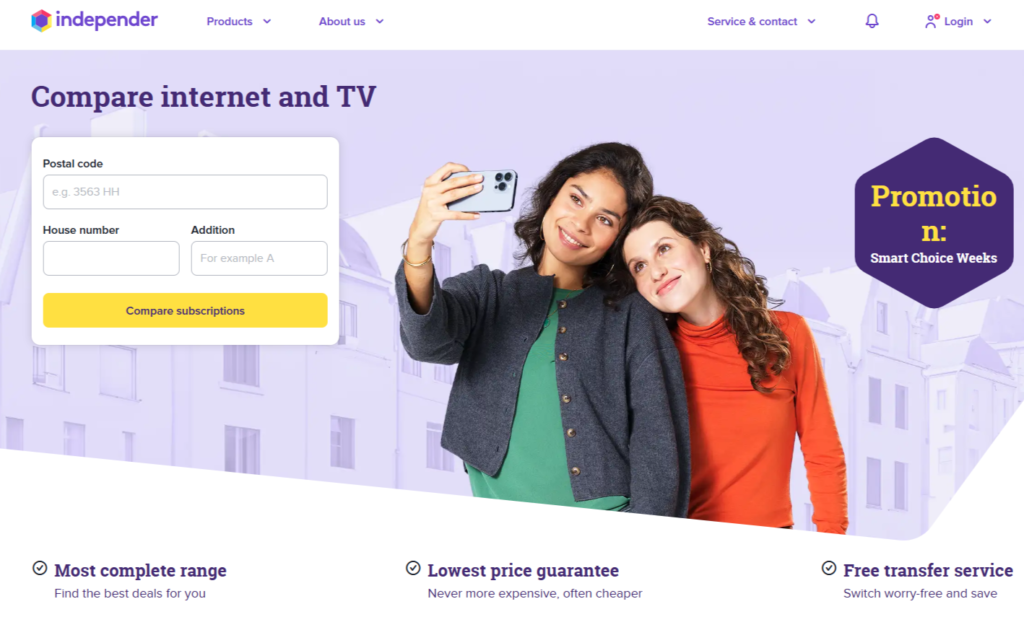
In the Netherlands, the best option is to be able to compare your subscription and switch to a better option. One of the leading platforms for the Independer, and you can just input your Postcode and House Number combination to receive up-to-date information about the latest and most excellent options.
Figure 2: Independer is a leading comparison site for various services available in the Netherlands.
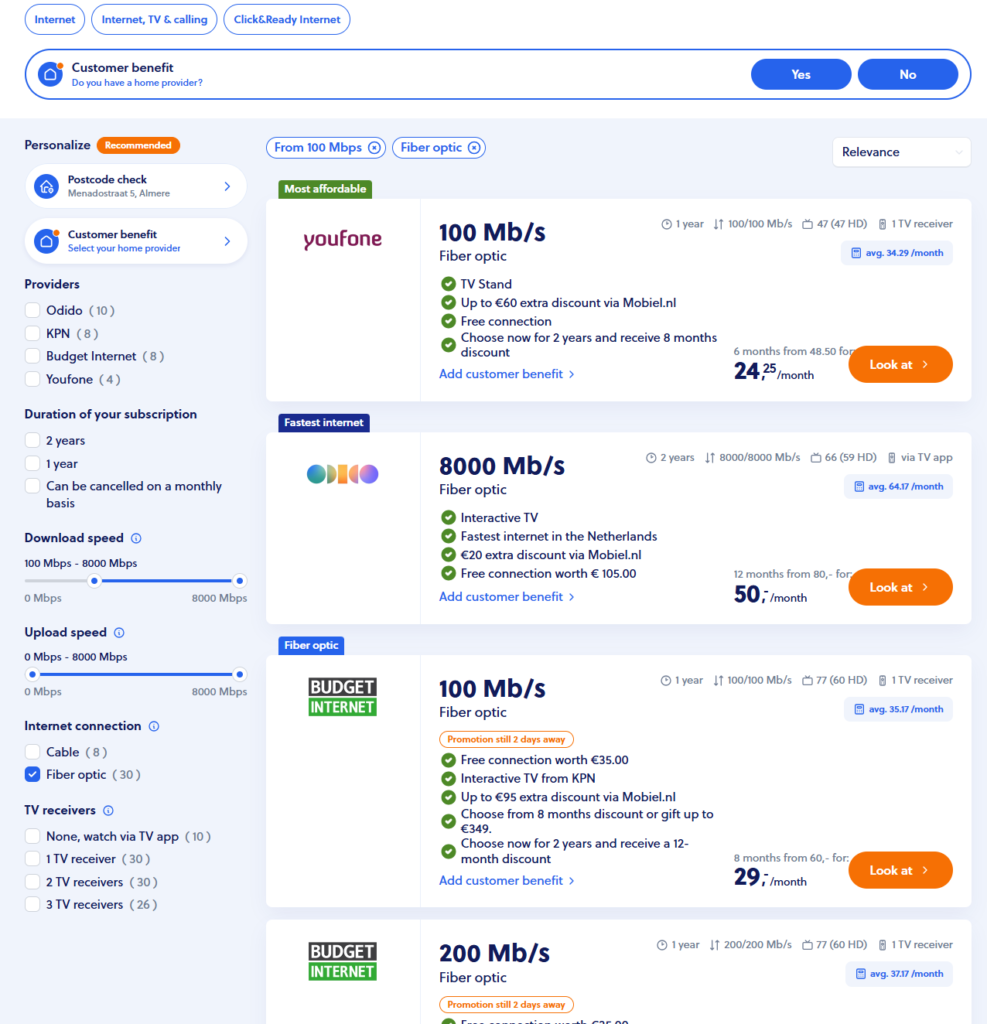
Once you input the details, you will be redirected to the Mobiel.nl website, where you will see all available options. The website separates the options into categories, such as “affordable”, “fastest”, and among others it also shows the terms for the contract.
Figure 3: Mobiel.nl is a website for purchasing and comparing mobile services.
You can take out a subscription from here or upgrade to a new one. Remember, in the Netherlands, you receive 14 days of mind change period during which you can cancel a subscription without any costs to you. Beyond the 14 days period the terms of the contract dictate what is possible and if any charges will be applied. Usually, you have to pay 1 month 100% (that is the notice period) and then you may have to pay at least 50% of the remaining contract months amount if you cancel early.
Personal Choice and Experience
I have been an Odido (formerly T-Mobile) customer for the last 5 years. My personal experience with Odido has been very stable, and their service doesn’t really need a reboot or a technician.
Service timeline
While I did not change my service provider, I did upgrade the connection and subscription a few times.
When I became a customer of T-Mobile, I ordered a 100 mbps plan for a year. The plan was quite cheap and they handled the installation. They usually send in a technician from Guidion. The installer set ups the device, and activates your connection. You can start surfing the internet the same day.
2
400 mbps
Soon after, T-Mobile updated their offerings and added a 400 mbps plan. I did not move to the 400 mbps plan, as 100 mbps was already stable, and enough for myself and my partner.
3
1000 mbps
I moved to a new house in 2022, and that is when I decided to upgrade the internet for a few years. I decided to go with a 1000 mbps subscription for two years, as the plan was at 50% discount for 6 months and costed me about the same as 100 mbps for the first 6 months. I am very glad I chose 1000 mbps plan.
I am still on the same 1000 Mbps plan, even though I plan to upgrade to 2000 Mbps soon.
Note: This is my personal blog, and this post is not sponsored by any providers that I have mentioned or not mentioned. 🙂
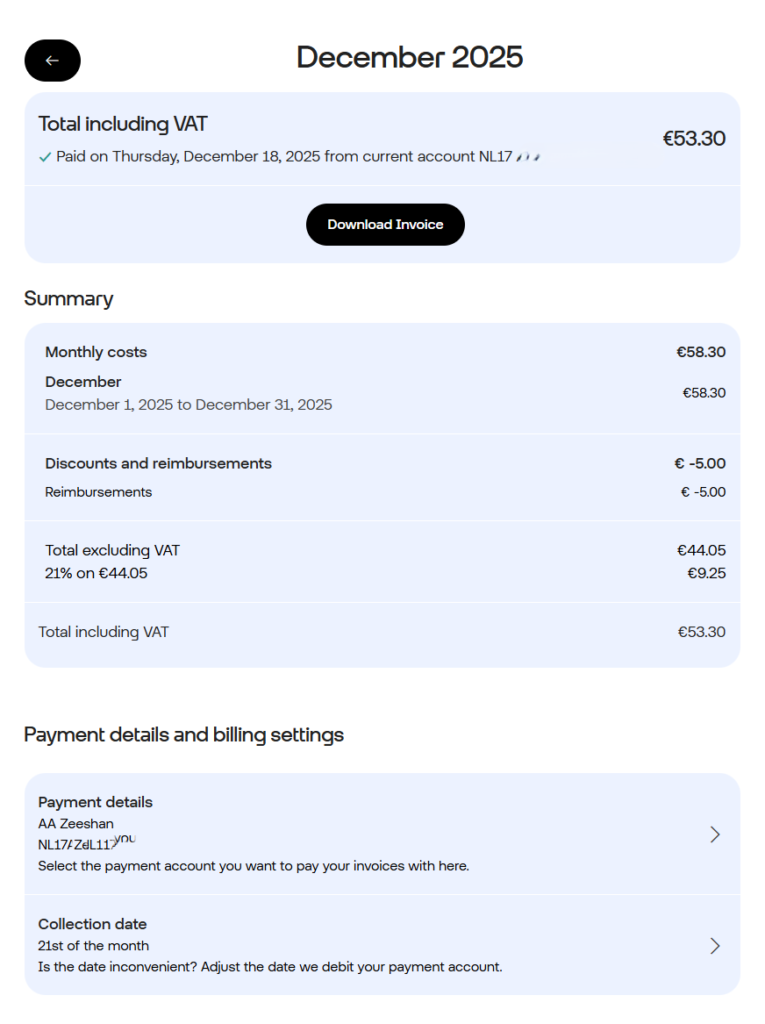
There are no flexible costs, hidden costs, you just pay one fixed monthly cost for your subscription. Here is the contract cost for my network connection.
Figure 4: My Odido invoice for the December 2025 month with an outline of what was paid and what was the discount.
This is the invoice for the month of December 2025. The fixed monthly costs are EUR 58.30 and I receive a discount of EUR 5 because I have two other connections (Odido offers a EUR 2.5 discount per connection on the same house address). The invoice is paid automatically from my bank account and I just recieve an email notification that everything is clear.
That’s it for this piece. Good luck with your service connection, and enjoy all the cat videos.
Summer is the Europe dream, and the winter is simply tough to plan for. In the Netherlands, winter usually starts around October with the rainy days, rainy nights, and cloudy skies making it difficult for even sun to say good morning.
My parents recently visited us here in the Netherlands and we wanted to take them out. The weather was wild, rainy, but the dine out made the day. All in all, it isn’t really the chills, but the fun bites that matter.
Autumn is very beautiful in the Netherlands, with fifteen shades of orange on the streets, a wet reflective surface on roads, and a calm and cool environment.
The leaves present a slippery but brisk way to walk across the street in the cold autumn weekends.
In the last 5 years here in the Netherlands, I learned the best way to deal with the winter is to spend time with people you care about, or who care about you. Go out for a walk, grab coffee together, watch the sunset, and tell a story or remember a memory.
The short days make it difficult to go for a long road trip, and the cold weather makes it difficult to enjoy the beach.
But, family, friends, they bring the warmth during winter.
Family dine out
We visited the Belqees Restaurant & Cafe — مطعم وكافيه بلقيس, and as always, really loved the family dine out experience. Even though we still call it “Yemen Restaurant” and love their “mandi”, they changed their name on Google Maps.
And that’s it for this blog, thanks for reading and watching. 🙂
From a developer’s perspective, it is no longer a hello-world testing world anymore. Todos are the new Hello World.
You’re doing groceries and you open the grocery list to find what items to buy and, boom, the list is no longer the last message in your WhatsApp chat thread anymore. Or, you have to scroll past a few messages to find the grocery list because you started another conversation.
Lastly, definitely it is possible to use Google Tasks or another application to create and share the lists, but as a developer you’d rather spend 10 days building something than 10 minutes using something that exists. I definitely chose the path to build something.
Developing the Backend
When I started working on the application’s API, I wanted to use TypeScript. I chose TypeScript for two reasons:
I wanted to learn TypeScript-based complete app development, testing, deployment, and patching.
I wanted to add a different tech stack to my belt–no, okay, I lied, I wanted to work with sequelize. It is one of my favorite ORMs (after Entity Framework Core, of course).
I developed the backend layer, which is barely an API that exposes certain actions that you can perform on the system. The API is exposed as a service, meaning, every interaction and action is done as a service; with your account + lists + tasks as the resources in the centre.
The application also has a static HTML page for the homepage. You can visit the website here: https://twodos.app.
The application is hosted on Microsoft Azure, and I am using Azure DevOps to manage the project and the entire software development lifecycle.
Using Flutter for UI development
Once I had the API ready, I tested it on Postman and via command-line based tests to perform user-journey actions. I knew it was time to do the UI. I wanted to give Flutter an opportunity to do the entire app development, cross-platform, and be able to patch and republish when possible and needed. The development went very smooth and I was able to target all major platforms. The objective I had was simple:
Make the application available on as many platforms as possible.
Keep the application simple.
The UI flows should correspond to the services and their features (the actions available).
For this reason, the Flutter was the perfect choice. Even though I have not been able to deploy a Linux version of the application, the other platforms work perfectly fine.
Oh, the iOS app was rejected by the App Store because it was too similar to other applications on the platform.
Flutter made it very simple to write the application as a UI layer for the backend services and communicate when an action was made. I used the following packages to speed up the development:
Retrofit: handling HTTP interactions with the server.
Provider: to handle state management.
I did not use Firebase because of a few reasons:
Firebase is not supported across all the Flutter platforms.
Analytics is useful, but, let’s be real. It is not supported for Windows, and that would mean either more work or less supported platforms.
I still need to work on the push notification support, but the goal with push notifications is not to handle background messages rather the updates to UI. Here is a quick use case:
You go to grocery shop and open the list for the grocery items.
Your partner (with whom the list is shared) updates the list of items in real time.
You receive the updated list in real-time without having to reload.
The items you pick up are communicated in real-time with your partner as you “tick” them.
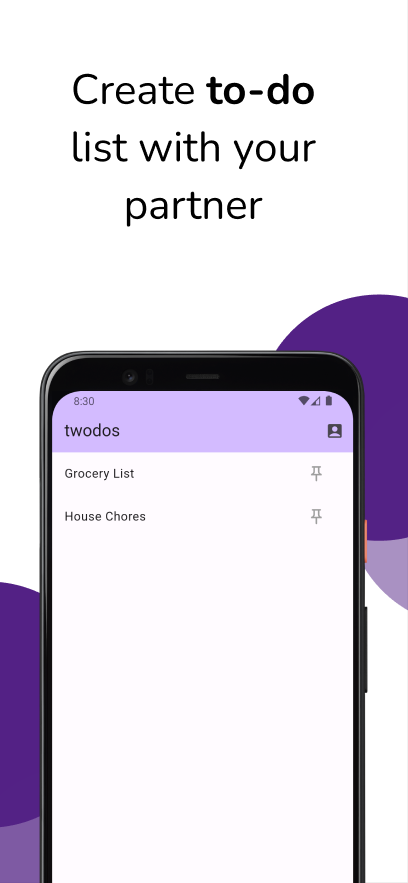
Figure 1: The goal of the application was always to make it easier to create lists and share the tasks and their current status with the partner.
The challenge with Flutter is that it is just a UI-development framework and a platform. It does not support anything complex, and once you start going down that rabbit hole you really see how Flutter lacks the performance–due to its declarative nature.
Roadmap
While the application is not a high priority for me, I definitely want to keep it active. For myself, at least. I would continue to add features and improve features or fix bugs to make the application stable. The goal is to:
Enable seamless accounts creation.
Enable push-notifications for in-app updates.
Allow blocking users or choose to keep your profile private.
Delete the lists and requests that do not receive interactions.
Make the app secure by running baseline privacy and vulnerability controls
Make the app building, testing, validation, screenshots, and deployment automatic via Fastlane.
Finally, not right away but another goal is to make the UI simpler so the interactions happen naturally and give a cross-platform twodos experience.
Download the application
Check out the application on the Play Store. The application is only available on Android for mobile devices, but is available on macOS or Windows platforms.
In the next blog, I will share the next updates as the application grows.